Thursday, December 14, 2006

Trust versus corruption

I've been spending my active time working on scaling up my favorite project, as you all know. But my less active energy (i.e. thinking, pondering, puzzling) is spent on two topics: Trust and Corruption.

Corruption came up at the tail end of reading William Easterly's "The Elusive Quest for Growth". Sure, we all know about it, but the impact on development is so big that it should dominate any policy discussion. There are sites, like Transparency.org and others, that spend their existence on the problem. A major issue is that no one has found a surefire way to eradicate corruption. Corruption has a corrosive effect on aid as well, since it impacts confidence that aid will go where it's intended.

By contrast, the hands-on development assistance delivered by small NGOs doesn't have nearly as much leakage. Much of my enthusiasm for Appropedia is due to my desire to crank up this approach to aid delivery, in part to increase the person-to-person contact between the developed and developing worlds. As I read about the challenge of corruption, I got even more motivated to promote small NGO aid delivery.

Now, as it happens I'm pretty much a greenhorn when it comes to delivering aid (though I hope to change that over time). So I knew I needed to connect with experienced people to see how the world really works, so that I could do the right things to scale the impact. Repeatedly, the key component to making a small NGO-to-community engagement work in the developing world is...trust. You must have a trusted man-or-woman-on-the-ground. It could be an expat, but those are fairly uncommon, so doesn't address the "scaling issue". So that means it will probably be a local. And you'll need to trust them. And they will need to trust you.

As I've been considering this conundrum, I came across Aaron's post, and had to laugh. Yep, that captures a piece of the problem! Sure, most of us in the developed world have probably seen (and perhaps even touched!) skin that's a different color than our own. And though there are bigger barriers than the visual differences, it's a great nutshell story for the magnitude of the gap.

So how do we bridge this trust gap, and (mostly) bypass corruption to deliver aid and build relationships? Ah, well, that's the puzzle.

My ideas for solutions include:
  • Changing the way we vacation in the third world, so that we don't rush past all the faces but find some way to stop and bond with at least a small number of real people for several hours. That by itself is important. Translation will probably be necessary. Locals that already speak a foreign language have probably bonded a lot and are somewhat westernized. Get them to connect you to someone who doesn't speak a foreign language.
  • Revive the "pen pal" notion to grow a relationship with someone you met while traveling. This could be challenging, given the translation thought...but there are now some amazing free translation tools on the web. Email pen pals require connectivity, though. So maybe your travel plans are part of an Inveneo project :-). Or perhaps it really does make sense to work on a deeper relationship with a local who speaks your language. This might lead to...
  • Looking for ways to support "exchange students", or just visitors, from the developing world for a few weeks in the rich world. It's hard for me to imagine someone sponsoring a visitor unless there have been quite a bit of contact (a la pen pal) over time. And I have no sense for the US visa challenges involved.
As I say, these are just thoughts. That will lead to action. That will make a difference. I'll bet you've got thoughts about making a difference. If you've written them down, please leave a comment with a link. If you haven't, please do some thinking, then start a blog or a journal and practice articulating your thoughts. Writing is a great way to bring a series of ideas into a coherently expressed theme.

Trust me.

(Or maybe you think this post is a counter example? :-)

Labels: , , , ,

Sunday, December 03, 2006

Burnin' it up


Wow, that was fast.
I kinda new it had been a while since I posted. No shortage of things to say, just... Well, y'know... Time.

But still staggering to look at the date of the last post and find that over two weeks have passed.

Anyway, just a temporary lapse. One of many, sure, but anyway I'm back. Once again a busy week at Lake Wobegon. There was Thanksgiving, of course, and it was one of the good ones. Won't go into that, though. In addition, I've met with several people, gone to another EWB-SFP meeting, where they had a great presentation by their Appropriate Technology Design Team (ATDT), including a great presentation by Ken on the Darfur Cookstove project.

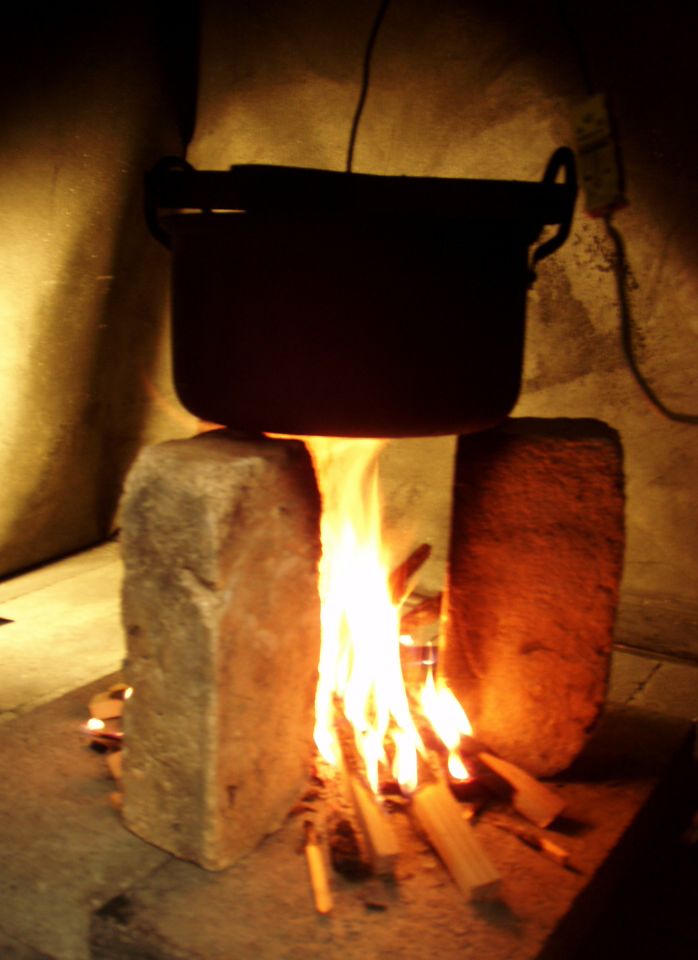
That one was particularly educational. Here are the highlights. There are about 2.2 million "IDP's" (internally displaced persons, considered distinct from refugees) in Darfur. Nearly all of them cook using the traditional "3 rock stove" technique (see photo, from ATDT Aprovecho blog post), which does not make very efficient use of fuel (i.e. firewood). Food is supplied by international aid. Fuel is supplied by gathering for nearby...except that over time the local area has been denuded of wood, and so now "nearby" means a 7 hour round trip to collect wood. Women and children perform the gathering, under threat of rape or mutilation. It's worse if men do it; the likelihood of murder is quite high. So there is value in reducing the need for collecting firewood. Solar cookers have been developed, but unfortunately the nature of the cookers does not allow for cooking of the traditional meals, and so the IDP's, desparate for a vestige of their lost lives, revert to the cooking they know, and the solar cookers have not been adopted.

ATDT got involved. They took a look at some existing FES's (fuel efficient stoves, yes it even gets its own acronym!) and found that, like the solar cookers, you could not cook the traditional meals. They also were very sensitive to wind, which tends to blow at around 6 mph in Darfur. They also wanted to develop a design for a stove that could be manufacture at a reasonable cost in Darfur itself! (It's hard, but there are lots of benefits to this.) So they made some tweaks and improvements, and have a version that looks very promising, using 1/4 of the fuel of the tradition scheme. This can make a huge difference, especially if the stoves can be made locally. Currently 50 proto stoves are undergoing testing by IDP's on site in Darfur. (Amazingly, this and other aid efforts have been hampered by travel restrictions imposed by the government in Khartoum. Apparently Nicholas Kristof's articles do not exagerate.)

Much of this (including some cool photos) is captured in the ATDT stove test blog post (this is a different post from the one referenced above). When I read this (ages ago), I noticed a comment that had been left. The comment poster essentially said "yeah, but what's this got to do with reality?" This was pretty much my reaction when I read the blog; I thought, well great, they've inched up efficiency another 3%, but airlifting 300,000 stoves to Darfur seems like the wrong priority of investment, and I figured solar cookers would make more sense. I was mistaken; everything was illuminated at the EWB-SFP meeting last week. I'm extremely impressed with the effort to engage the local IDP's in manufacturing, using materials and tools and skills available in Sudan. And there's more. They're even finding clever ways to fund this, such as a form of carbon credits, since the new stove reduce the amount of carbon released into the atmosphere by several tons over the life of the stove. Wow.

I also met with Marc, the director of The Clarence Foundation, which is doing some great work on giving circles, including a "traveling giving circle" which will make some decisions in Nairobi early next year (there's still room, I think). I'm very excited by that, and will be joining up in the new year. Also contacted Robin, who is working to improve the lives of villagers near Kilimanjaro via Hope Through Opportunity, as well as Natalie, who recently visited west Africa and wants to help make an impact on education there. Several people have been joining the effort at my favorite wiki, where page views have been skyrocketing, probably as a result of some promotional work, as well as some very successful porting efforts. (Plus, of course, it's just a damn great idea.) We've been porting (with permission, of course) some great material from the Erssons, Practical Action, International Rivers Network (along with American Rivers), and G.P.Baron of Philippine BioDigesters (really). Numerous other contributors are creating some original content as well.

And in the coming week I'm gonna be meeting with Doug, and John, and Ken and...

But I promise to write a post...though it could be a 2 liner. (Did I hear someone say "Is that a threat or a promise?")

Labels: , , , ,

Saturday, November 11, 2006

It's all about the content

I have once again disappeared into the Vortex, this time spending most of my web moments porting an excellent document by Elizabeth Brink of IRN (and AR?) called "Beyond Dams" to (yep) Appropedia.

Beyond Dams talks briefly about the various undesirable impacts of dams, especially large ones, on the ecosystems (including humans) related to rivers. (Tracy Kidder repeatedly mentions such a "bad dam" in Mountains Beyond Mountains. The all time biggy must be China's Three Gorge Dam, which was completed after "Beyond Dams" was written.) The doc goes on to talk extensively about alternatives solutions to many of the problems that have motivated dams in the past. Many of the solutions are very valuable and interesting independent of dams. For example, rainwater harvesting diminishes the need for dams in a couple of ways, but is useful technology even if dams are not in the picture.

Porting this doc has been seriously educational, getting me pointed to a remarkable couple, the Erssons, in Portland. Most of us live lives of such large resource impact ("ecological footprint") that if even a modest fraction of the world lived in the same style we'd all be toast in short order. (Check yours here.) But the Erssons demonstrate that a tiny footprint is achievable in an urban environment, and their achievements are inspirational. I highly recommend that you drop by for a visit. It's a delightful site!

So, anyway, I haven't totally disappeared. But you can tell I'm swamped when I miss an easy opportunity to post about Appropedia's new logo. Check it out; I find it totally cool. It's been up for over a week now, I think, and barely seems newsworthy any more, so only rated this brief mention.

But perhaps I can poke around and get some "web buttons" (or whatever they're called) put together for Appropedia, and we can offer them to other sites (like Resolution) for help with promotion.

Labels: , , , , ,

Sunday, November 05, 2006

Grass roots world peace

I've gotten so involved with Appropedia that I sometimes lose track of the bigger picture, why I got engaged in the first place. I'll take this opportunity to remind myself.

My first humanitarian passion, world peace, is not so purely humanitarian as it might seem. It's pretty easy to see the self-interest in world peace; I want to help build a better world for my kids. Sure, I want it for everyone's kids, but since I'm thinking of mine, there is some pretty straightforward self-interest in the neighborhood.

My troubles in trying to get involved with world peace was that much of the focus seemed to be on government and policitical leaders and demonstrations. Not all, of course, but a lot. I wanted to get more personally involved. What can an individual do? How can I live differently in support of world peace? If millions of us take that approach, we will make an impact, and at the same time we will alter the electoral dynamics, which will lead to changes in many of our political leaders. Fifty years ago, political leaders in America didn't discuss environmental issues. Now it is at least a part of the discussion. There is little talk of world peace today, but we can influence whether it is part of the platforms in 20 or 30 or 50 years.

As I dug a little deeper, fortunately, I found more ways to engage in world peace. A key path is education coupled with improving intercultural understanding. Another is the reduction of inequity. Somewhere in this path of discovery I got the "wiki idea" and started my proto wiki, WinWinWiki. A couple of weeks into that effort and I discoved Appropedia and shifted focus to that worthy site.

And there is the circle. Even though Appropedia is more focused on sustainable development (and WinWinWiki was going to aim a bit larger, to include policy discussions and world peace teaching materials, etc), I can still very easily see the connection between the visions of Appropedia folks, and the path to world peace.

It's so great today to see travel sites including humanitarian vacations. Rotary is deeply involved worldwide. Pop stars in various media are raising awareness. But still it's early days. The efforts are diverse and uncoordinated. That's fine, and yet I see some advantages of having a smaller number of sites (dozens instead of thousands?) where people can go to get the information they need. My own investigative efforts were quite frustrating. How many gave up before learning what they were interested in? How many more will engage if they can see how easy it is to get involved?

Thats were infrastructure efforts like Appropedia are aimed. By themselves, they don't do much. But if they help all the other efforts be more effect, and raise awareness in the masses, well then there are ways to improve quality of life for developing countries, and for the children of people, like me, in developed countries as well.

Labels: , , , ,

Tuesday, October 17, 2006

Engineers Without Borders, Unlimited

I just spent several minutes reading the Mission and Vision of EWB-USA. What a remarkable group! Now, I have to acknowledge that there are tons of remarkable groups out there. Still, I'm struck by their approach, captured in this sentence:

EWB-USA promotes a new way of thinking for the engineering profession and provides unique opportunities for engineers to work in partnership with a wide range of stakeholders such as communities, social scientists, public health officials, economists, businesses, and international development organizations.

What I really like about this is the straightforward acknowledgement of the large eco-system that is involved in making change happen in the third world. EWB's articulate vision helps me to clarify my own vision. I want to help facilitate this eco-system!

What can be done to facilitate? Pardon my geekness, but I'll answer it this way. One kind of facilitation can be achieved through publishing "open API's". (API's are "application programming interfaces".) What I mean is, if each stakeholder, or group of stakeholders, openly announces the ways in which they prefer to connect with or work with the other stakeholders (i.e. "interface"), then the various players can much more easily support one another. Here's my example.

EWB mentions the social scientists group. I take that to include anthropologists, who may be doing regional assessments, like Paul Farmer, the MD/Anthropology PhD, did in Haiti. In an "open API" approach, EWB could proactively say, "If any of you anthropologist groups happen to be performing assessing a region, here's the information that we would really find usefu for determining water supply issues, and here's another set that's very helpful for building schools." Chances are, adding a few items to an assessment is only incrementally more work. Then the village organizations can chip in and gather much of the information in the absence of anthropologists. Another group, like Engineers for a Sustainable World, can say "Here's our list of desired info for planning sanitation projects." Then the economists and health professionals can chime in with reports that help prioritize (the unfortunate reality) of schools with respect to hospitals for a given region. Charitable organizations and NGOs can plan fundraising for different kinds of projects because they have a fair idea of the cost. Social scientists can train for the appropriate translation skills because they know the topics that need to be covered. Pretty soon, Version 2.0 of the API's evolves, and each group gets what they need without having to repeat half of the effort of another group.

With "standardized interfaces", each group can do its job more effectively. The work becomes a little bit "commoditized", which helps, but there is still room for "differentiation", and different approaches. That's cool, because the more, the merrier. A little "healthy competition" keeps us all at the top of our game.

So, thank you, EWB! For supporting the Sustainable Development Open API Version 1.0! I look forward to the first release of the draft standard. And it won't surprise you to hear that I'd like to see the draft published at Appropedia. That's what we're about over there: sharing information.

Labels: , , , , ,

Sunday, October 15, 2006

Appropedia gains momentum

I'm excited to see the level of activity at Appropedia at the moment - every day when I check the recent changes, there's new pages and more maintenance being done to improve the site.

I'm not able to spend all the time I'd like to, but I also keep coming across stuff I want to put on Appropedia. So I've been trying to focus, and avoid getting into the discussions too much, only contributing where I've got something to add and leaving much of it to other competent contributors. Not easy for a natural-born schmoozer like me. But I'm still keeping an eye on things, and adding material when I can - I just added Human-powered devices‎ and Washing and drying clothes‎.

I'm very
much appreciating the work that Curt, Lonny and others are putting in. It feels so much more active (well, it is much more active) with Curt on board. With more awareness-raising, things will get even better.

Labels: , ,

Monday, October 09, 2006

The Wiki Synergy Project

At the moment, I'm trying to think about key strategic ways to advance the aims of Appropedia, i.e. promoting sustainable development and providing and developing ways to beat poverty. The ultimate aim is not to promote Appropedia, but rather the good things that Appropedia stands for.

One of my concerns is that there's a lot of small groups working on these issues, and they could really benefit by sharing information more effectively. For example, instead of having multiple wikis about sustainability issues, why not focus our effort on just the active one(s)? And let's avoid duplicating our efforts - there's no point in two groups developing the same resource in two different places.

See The Wiki Synergy Project (at WikiIndex) for more info, especially the section on Sustainability, environment, & international development wikis. If you follow the links, you'll see the various wikis on these topics - some of which are active, many of which are not.

Labels: ,